Email is the information currency of the professional world, and the number one way professional people communicate. Focus on the subject line, greeting, body of the email, and signature to demonstrate professionalism in your email communication.
Subject Line

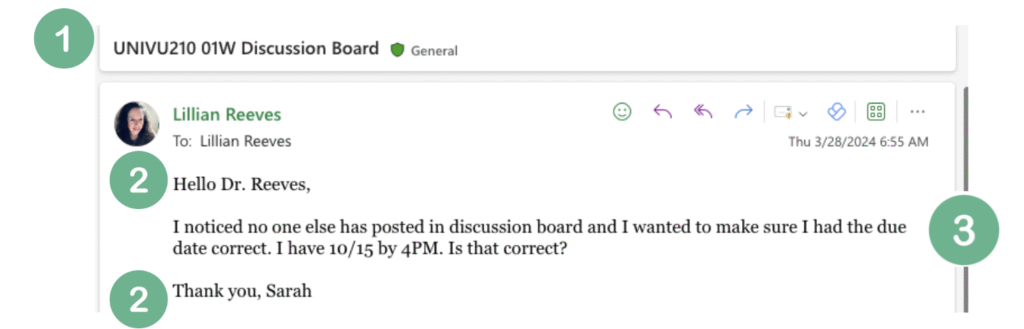
When emailing faculty, include a brief description of what the email is regarding and the course and section number. This info can be found at the top of the Blackboard page.
Example: UNIVU210-01W Discussion Board.
Professional Address

Address your instructor (or employer) in the opening line, then sign your name at the end of the email. By addressing the person you’re emailing in the way they prefer to be addressed, you help them focus on your request.
Example Greeting: Dear Dr. Smith or Prof. Smith,
Example Signature: Thank you, Sarah Jones
Body of the Email
Share your questions or other content in 3-5 clear sentences. If you cannot express your needs in that space, consider visiting office hours or setting up a virtual meeting.
Example: Dear Dr. Smith, I noticed no one else has posted in the discussion board and I wanted to make sure I had the due date correct. I have 10/15 by 4pm. Is that correct? Thank you, Sarah Jones

Before You Hit Send

- Know that you are writing to someone who will answer your questions, who is willing to help you, and who wants to see you succeed.
- Know that your questions and confusion are valid and you can ask them without embarrassment.
- Practice using a neutral, professional tone.
- Review your email for grammar, spelling, and clarity.
Anatomy of a Professional Email