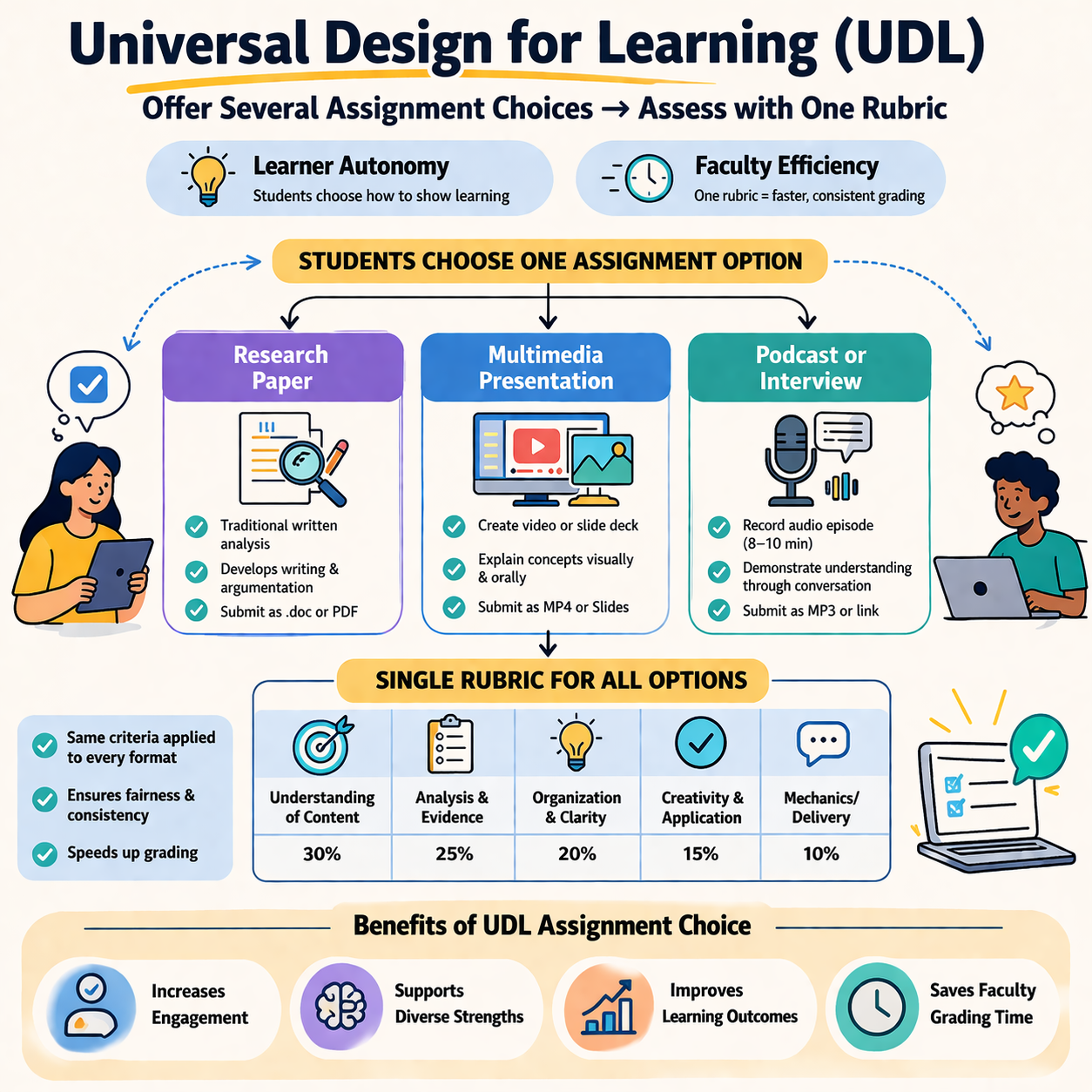
Over the past several years, USC Upstate faculty have worked diligently to revise and update course materials and are well prepared to meet the April 2026 WCAG compliance deadline. These efforts have resulted in more accessible PDFs, PowerPoint presentations, documents, images, and videos, expanding access to barrier-free course content to a wider range of students. As we build on this important technical foundation, we also have opportunities to think more broadly about accessibility in course design, including how emerging practices like Role, Context, and Task Prompt Engineering can expand the adoption of more Universal Design for Learning practices.
Continue reading “Using AI to Expand Universal Design for Learning”
AI Resilient Learning is All Around Us
Thinking aloud is a simple yet powerful cognitive tool that anyone can use. When students verbalize their thinking process, they slow down, clarify their understanding or misunderstanding, and make their implicit knowledge explicit. They’re not just giving an answer; they are explaining the how and the why of the answer.
Continue reading “AI Resilient Learning is All Around Us”
Get Started with the ACUE Learning Lab Today!

What is the ACUE Learning Lab? USC Upstate’s year-long partnership with the ACUE Learning Lab provides faculty with access to 11 evidence-based Quick Study Courses, offering best-practice guidance to enhance student success and engagement.
What are Quick Study Courses? Quick Study Courses are comprised of short, effective videos and implementation guides collaboratively developed with subject-matter experts. Once faculty have engaged with the content, they are prompted to complete a short reflection.
How long does it take to complete a Quick Study Course? The courses are self-paced, and can be completed in 1-2 hours.
Continue reading “Get Started with the ACUE Learning Lab Today!”
Contract Grading Increases Student Engagement and Reduces Anxiety
Have you ever had a student approach you and ask, “Dr. Reeves, what do I need to do to get an A in your course?” I have. I often suggest reviewing the syllabus and the percentage points associated with each grade category. I suggest reviewing the rubrics, planning ahead for upcoming due dates, and working with a partner to stay motivated and in conversation about course topics. While these are useful suggestions, they don’t necessarily address the quality or quantity of work students must create or give them the autonomy and choice they crave to build the knowledge and skills necessary to take their thinking to the next level. One way to better answer this familiar question and increase student motivation, autonomy, and responsibility (Hiller and Heitapelto, 2001; Strong et al. 2004; Danielewicz and Elbow, 2009; Bonner 2016; Litterio 2018) may be to adopt contract grading. Though many of the contract grading studies have been designed for and implemented in courses with a writing component, the models are easily adapted for other types of courses, as well. If you’re interested in exploring some examples of contract grading, check out the 3 models below.
Continue reading “Contract Grading Increases Student Engagement and Reduces Anxiety”
Motivation After the Midterm
When students feel motivated to learn (University of Buffalo, UW-Whitewater, Kennesaw State), we’re likely to see increases in effort, energy, curiosity, and creativity. We might notice they come to class more, are better prepared, and generally seem open to tackling challenging content or leading a group project. Sometimes, though, even the most motivated students can show a dip in their engagement after midterms, and everyone can use a pick me up to push through the second part of the semester. If you’ve noticed this happening in your classes, try these evidence-based practices to reenergize yourself and your students for the next part of the semester!
Continue reading “Motivation After the Midterm”Active Learning Leads to Student Success

Ten years ago, USC Upstate launched its first Active Learning Institute and installed its first active learning classrooms with support from a Title III federal grant. Today, we have 11 state-of-the-art, flexible classrooms in 6 buildings and 100s of enrollments in active learning classes each year.
The results of this 10-year effort are impressive. Over 8,000 unique students have enrolled in active learning courses from 2019-2024 alone. Of our current faculty members, 74 are Active Learning or Engaged Pedagogy Fellows, and many more faculty–especially adjunct faculty–have used their active learning credentials to successfully find full-time teaching positions.
Even more significantly, 94% of the students enrolled in active learning courses from 2021-2023 persisted–meaning they either graduated successfully or returned to USC Upstate the following semester to continue their academic careers. Of the six recent teaching excellence award winners featured in our fall faculty spotlight, three are Engaged Pedagogy Faculty Fellows and one is an Active Learning Faculty Fellow.
What Is Active Learning?
Active Learning is a high-impact teaching practice that meaningfully engages students in interactions with each other and with the course content to enable them to be “co-creators of knowledge.” Students are active participants in class sessions and in their own learning. Implementing active learning strategies means shifting the focus of instruction away from transmitting the instructor’s knowledge to constructing the learners’ knowledge and skills through guided tasks, interactions, assignments, and environments that cultivate deep, meaningful learning.
Active learning strategies can be used in any instructional mode–from face-to-face to online–and in classes of any size, including large nursing or anatomy and physiology courses. USC Upstate’s intensive Engaged Pedagogy and Hybrid Course Design Institute helps to prepare instructors to design hybrid courses to take advanced of flipped learning in online spaces along with rich, interactive learning face-to-face.
Find out more information about Active Learning in our CAIFS Resources for Innovative Course Design. Check out our profiles of Engaged Pedagogy Fellows Astrid Rosario (NSE), Kristi Miller (MBCON), and Shannon Polchow (LLC) to see active learning strategies at work in USC Upstate classrooms.
