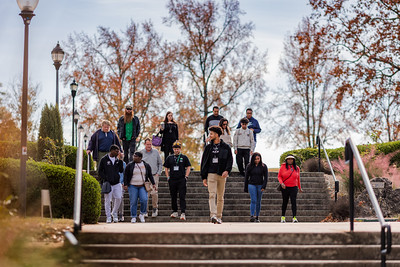
The image shows 12 USC Upstate students walking down outdoor stairs in campus.

What Students Want

At the start of each semester, CAIFS hosts a very short and optional Blackboard Ultra Quick Start course for incoming students. The goal of the course is to invite students to explore the LMS and try out the discussion board, assignment submission, and Yuja video quiz so they have some level of familiarity and comfort with the learning environment before classes begin. The discussion board prompts students to discuss how comfortable they are with digital tools and to share some goals for the semester ahead and how they plan to achieve them. Of the students who engage with the course, almost all of them say they feel pretty comfortable with different digital tools, they want to establish and maintain a 3.5 GPA or higher, and they hope to meet some friends. These qualities and experiences that they hope for all contribute to and support student well-being and belonging. So what can we do to help students expand their tech skills, get the most from their courses and major, and find some friends? 

Expanding 21st Century Tech Skills

Now that USC Upstate students have shared with us that they feel pretty comfortable with common tech tools, what can we do to increase their comfort with and use of 21st-century skills? One consideration is to embed technology use within authentic disciplinary tasks rather than treating technology as a standalone skill or course. We might ask students to use technology to analyze data, collaborate digitally, evaluate content and sources for accuracy, and communicate to different audiences across multiple platforms. Designing assignments that require students to select tools intentionally, document their decision-making, iterate based on peer and instructor feedback, and reflect on ethical considerations, like accessibility, data privacy, and AI use, can improve student motivation and engagement. It also invites students to build durable, transferable skills beyond specific tools or disciplines. If you’re interested in learning more about tech-integrated authentic assessment, explore Digital Authentic Assessments (DAA) in the article, Authentic Assessment in Higher Education: The Role of Digital Creative Technologies.   

Nurturing Academic Persistence and Career Readiness

Faculty can also play a role in supporting students as they reach their academic and career readiness goals. Instructional practices that support persistence, like transparent assignments, scaffolded skill development, timely and actionable feedback, and opportunities to revise, build students’ confidence and sense of belonging, especially in 100 and 200 level general education courses. At the same time, students are interested in their career prospects and rely on faculty to make disciplinary skills explicit, to provide access to simulations or applied projects, and to guide them through the practice of communication, collaboration, and problem-solving like a historian, nurse, educator, or other professional. Small shifts in how we describe our assignments can make a huge impact: by naming the transferable skills, inviting students to reflect on how course learning connects to several careers, and aligning assessments with career-focused expectations, we can guide students toward achieving their academic and career goals. To learn more about integrating career readiness into your courses, reach out to Lillian Reeves (reeveslg@uscupstate.edu) to learn about how to access ACUE’s Quick Study course on that topic.  

Finding Friends

While students have plenty of opportunities outside of class to meet people, they also spend a lot of time in class, which makes it the perfect place to meet a friend or two. Faculty can play a small, but powerful role in helping students meet their peers by designing classes that make connections feel natural. Small group work, low-stakes peer discussions in the early parts of the semester, and in-class collaborative projects with clearly defined roles can give students the repeated opportunities they need to get to know each other. When students have opportunities to speak and be listened to, community can emerge. To learn more about how to nurture the kinds of connections that lead to student success or to add some new strategies for building community to your practice, visit Elon’s Center for Engaged Learning and read the free copy of Peter Felten and Colleague’s book, Connections are everything: A college student’s guide to relationship-rich education. 

Students come to college often full of hope and nerves. In recognition of both, we can listen to their aspirations and create opportunities for them to achieve their goals and make lasting connections with peers, faculty, and staff. Evidence across institutional size, rank, and geographic location in the United States has shown that relationships enrich the college experience and strengthen students’ sense of belonging immeasurably. In this way, fostering connections becomes a powerful – if often overlooked – dimension of student success.  
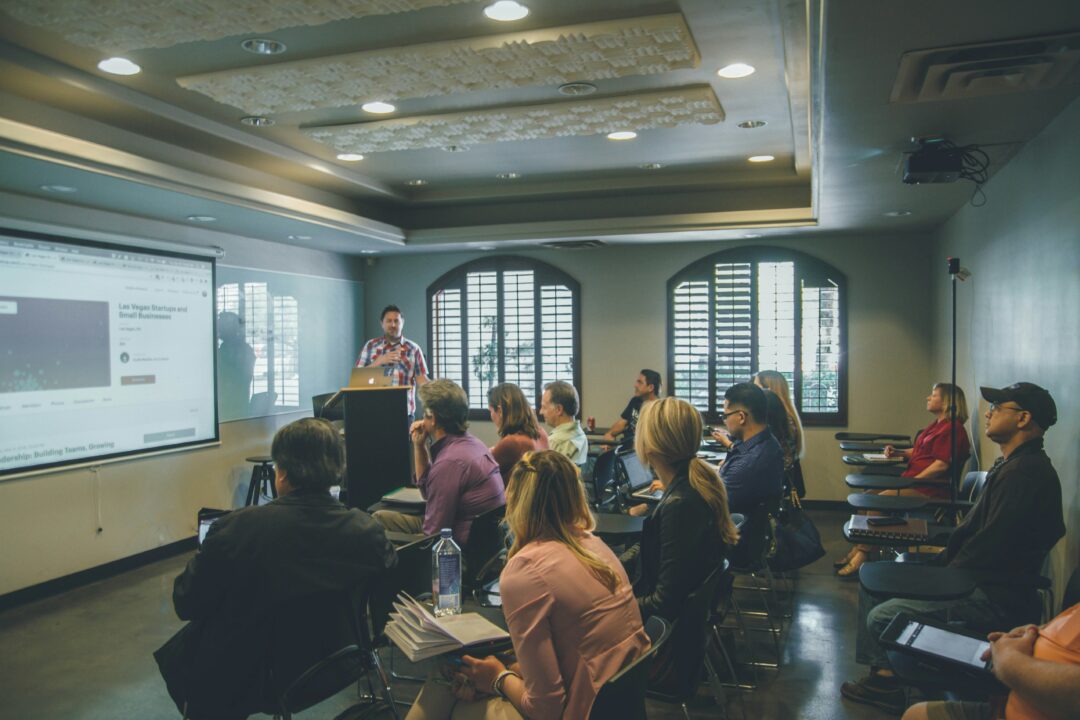
Faculty member speaking at a small podium to the side of projection slide. Three rows of students face the projection screen.

Building Classroom Connections, One Name at a Time

Peter Felten recently gave a memorable workshop for USC Upstate’s Fall Faculty Day. In addition to being a kind, funny, and passionate student advocate, he left us with plenty to think about – and to act on – as we launch into the fall semester. Much of his research shows that small adjustments in faculty and staff interactions with students can make a huge impact. One such small adjustment may be learning our students’ names in the first few weeks of class. Learning and using students’ names builds trust and can help create a supportive and inviting classroom environment. It also forms the basis for how we can ensure every student experiences “genuine welcome and deep care. All students need to understand that they are valued as people.

Continue reading “Building Classroom Connections, One Name at a Time”

A Quick Guide on How to Write Professional Emails: Student Edition

Email is the information currency of the professional world, and the number one way professional people communicate. Focus on the subject line, greeting, body of the email, and signature to demonstrate professionalism in your email communication.

Subject Line

person carrying an outsized envelope

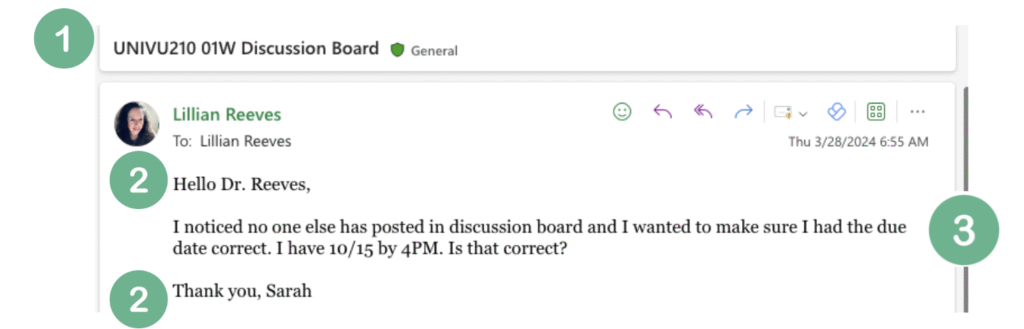
When emailing faculty, include a brief description of what the email is regarding and the course and section number. This info can be found at the top of the Blackboard page.

Example: UNIVU210-01W Discussion Board.

Professional Address

Professionally dressed person waving

Address your instructor (or employer) in the opening line, then sign your name at the end of the email. By addressing the person you’re emailing in the way they prefer to be addressed, you help them focus on your request.

Example Greeting: Dear Dr. Smith or Prof. Smith,

Example Signature: Thank you, Sarah Jones

Body of the Email

Share your questions or other content in 3-5 clear sentences. If you cannot express your needs in that space, consider visiting office hours or setting up a virtual meeting.

Example: Dear Dr. Smith, I noticed no one else has posted in the discussion board and I wanted to make sure I had the due date correct. I have 10/15 by 4pm. Is that correct? Thank you, Sarah Jones

Before You Hit Send

Person smiling and standing confidently with hands on hips
  1. Know that you are writing to someone who will answer your questions, who is willing to help you, and who wants to see you succeed.
  2. Know that your questions and confusion are valid and you can ask them without embarrassment.
  3. Practice using a neutral, professional tone.
  4. Review your email for grammar, spelling, and clarity.

Anatomy of a Professional Email

Screenshot of a sample email with 1. Subject line with course and section number, 2. Greeting and Signature, and 3. Concise and professional body of the email.

Creating Constellations of Meaningful Relationships

When I was in college, one of the RAs would host a weekly watch party for one of her favorite shows, The West Wing. Most of us did not have TVs, so anyone in the dorm or anywhere on campus who heard about it and wanted to go was invited. With her RA funds, she provided food, drinks, and some of the comforts of a home many of us craved. Students arrived early, and stayed late, even when it meant trudging across a snowy campus for the 42 minutes of anticipated joy and fellowship. When she graduated and became a staff member with campus housing, she continued to offer the beloved watch parties. In Peter Felten and Leo Lambert’s book Relationship-Rich Education: How Human Connections Drive Success in College (2020), the West Wing watch parties might be considered one star in what they described as “constellations of meaningful relationships” and experiences students need to feel genuine belonging that can lead to academic success and persistence.  

Continue reading “Creating Constellations of Meaningful Relationships”
A table with several chairs and a floral centerpiece

Breaking Bread: Take a Student to Coffee or Lunch

When you sit down together at the Spartans Table, you belong.

The Spartans Table program offers students, faculty, and staff an opportunity to interact in informal settings in the Spartan Cafe in the Sansbury Campus Life Center or the Perk Up Cafe in the Library. Have your lunch or afternoon coffee on us. 

Belonging Matters

To belong in a space is to feel accepted, valued, heard, seen, and comfortable. It is to be recognized as a fellow human sharing the same journey. Advising and mentoring practices that humanize our relationships with each other increase students’ sense of belonging and make it easier for them to succeed.

One great way to break the ice in a relationship is by breaking bread together. Spartans Table makes it easy for faculty and staff who work with, mentor, advise, or teach students to engage in these informal relationship-building activities.

How to Get Started

  • Faculty or staff fill out this request form  
  • Upon completion of the form, you will be emailed tickets for yourself and your student(s)
  • Redeem the tickets at the cashier’s station
  • Fill out the very brief survey that will be emailed to both you and your students following your meeting.

*Faculty/staff may participate in the program twice per term. Expenses may be covered once per student, per course, per term. 

Conversation Starters

  • What is your favorite place on campus and why? 
  • What classes are you looking forward to taking and why? 
  • What is the most surprising thing you’ve learned so far?
  • What out of class experiences are you most excited about?
  • When you have faced challenges in the past, how have you addressed them?
  • Where you do imagine yourself in five years, and what’s your next step to getting there?
table with chairs and flowers on table

Relationship Matters: Casual Conversation as Pedagogy

by Dave Marlow

When you sit down together at the Spartans’ Table, you belong.

Belonging is a primary factor in student retention (Costello, et al., 2022). Students who feel connected to their university are more likely to persist in their educational goals. Interacting informally at the Spartan Cafe in the Campus Life Center or at PerkUp in the Library may encourage at-risk students by giving them a personal connection, allowing them to see your human side, and opening up opportunities for them to ask questions or share information that they would avoid in more formal settings (Tinto, 1975). The Spartans’ Table program provides opportunities for faculty and staff to share a meal or coffee with students, and CAIFS will pick up your tab.

A casual conversation with professionals contributes to students’ career readiness as it offers them experience in soft skills (Guerin, 2015) and social intelligence (Ganaie and Mudasir, 2015) which are critical to success in nearly every career field. The rapport enabled by such conversation also contributes to students’ success in disciplinary content (Granitz, et al., 2009).  Finally, connections to campus matter greatly in the student experience (Cuseo, 2008) – especially for students like ours who work multiple jobs, spend little time on campus and view their on-campus time as a necessity rather than a pleasure.

Good things happen when we talk to each other. Sodexo and the Provost’s office, together with the CAIFS team, offers all faculty (adjunct, non-tenure track, and tenure track) and staff (e.g. advisors, students affairs staff, etc.) will buy lunch or coffee for both you and your students up to twice per semester (sign up on the Spartan’s Table website).

ALL faculty and staff, full- and part-time, are welcome to join students at Spartans’ Table!

Research suggests part-time instructors and staff have a powerful impact on students.