
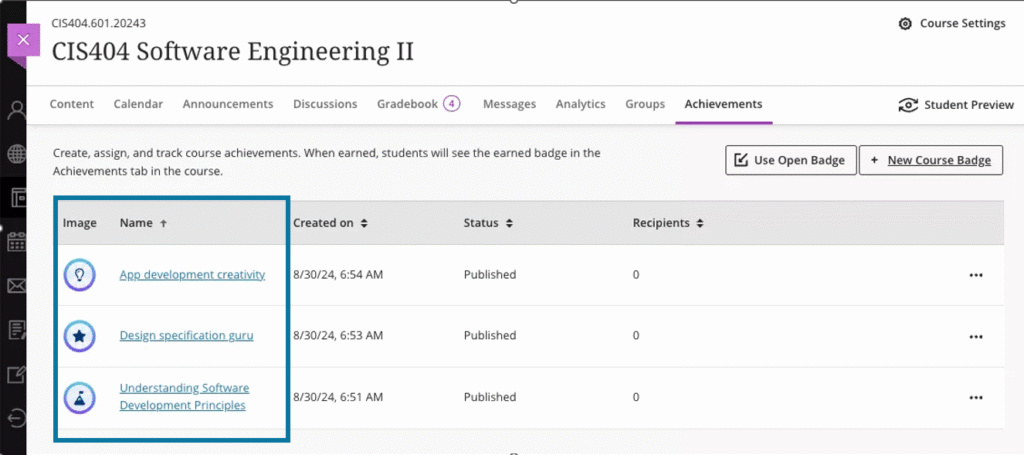
If you’re looking for a fun, motivating way to boost student engagement, consider using the new Achievements feature in Blackboard Ultra. From the Achievements tab, faculty can create course achievement badges and set criteria for student success. While faculty can review which students have earned a course badge, students can also see the requirements for how to earn a badge and monitor their earned and unearned badges.
Monitor Progress Toward Achieving Course Outcomes
One powerful use of course achievement badges in college courses is to mark clear progress toward achieving the course outcomes. When students complete the specific assignments or activities tied to a particular outcome, earning a badge can provide recognition that reinforces the purpose behind the work. This approach helps students see the direct connection between what they are doing and what they are expected to learn, making the somewhat abstract concept of “course outcomes” more tangible. It also allows instructors to highlight and even prioritize particular assignments that will directly contribute to students’ achievement of learning goals.
Choose Your Own Adventure
Another option is a “choose your own adventure” approach that gives students flexible ways to demonstrate their learning while still meeting course outcomes. For example, by offering a menu of 10 possible badge-earning tasks and allowing students to select any 6 or 7, instructors can support learner autonomy and differentiated learning pathways. In this approach, students can choose activities that align with their interests and strengths, whether that’s completing a case study, leading a discussion, creating a multimedia explanation, or completing community-engaged learning projects. Ideally, every pathway is intentionally designed to achieve the same learning goals, ensuring that all students reach the required levels of proficiency while feeling a stronger sense of ownership over how they get there. This model keeps the course both rigorous and engaging, supports the Universal Design for Learning Framework (UDL), and adds a layer of personalization that often encourages students to persist in their learning.
Competency-Based Learning
Badges can also be awarded for earning a particular number of points or reaching a specific performance threshold on key assignments. In this model, achievement badges may be viewed as motivational markers that reward effort, improvement, and competency. Students can track their progress toward earning a badge – such as scoring above average on quizzes, tests, exams or projects – which may encourage consistent engagement with course materials. Performance-based badges may be especially helpful in courses that use a point system by encouraging students to set incremental personal goals that indicate whether they are making good progress or whether they may need some additional academic support.
Career Readiness
Another way to use achievement badges is to recognize the development of career-readiness skills such as leadership, communication, teamwork, and critical thinking. These skills often emerge through participating in group projects, peer feedback or peer teaching experiences, reflective writing, or problem-solving activities. Awarding badges for career competencies helps students identify the transferable skills they are building through coursework. This approach highlights the value of course activities beyond content knowledge, reinforcing that the classroom is also a place to cultivate the skills employers most want to see.
Achievement badges can bring clarity and energy to college courses by making learning outcomes visible, motivating students, and adding a sense of personalization to their progress. If you’re ready to give achievement badges a try, start small. Experiment with achievement badges in a single course or for a single course project and see if it changes the way students engage with the content.