
When students see the relevance of course content in their own lives, they are often more motivated to study, strive for excellence, and succeed. Introducing practical applications can help students connect abstract disciplinary concepts to the kinds of questions they are already asking in real world contexts.
Specialized Generative Artificial Intelligence (GenAI) tools, like the Khanmigo Real World Text Generator or NotebookLM’s podcast-style audio overview, offer inspiration for instructors to integrate examples and cases that increase relevance and motivation.
Khanmigo Real World Text Generator
Khanmigo is an AI Learning Tool offered free to educators by Khan Academy. It is trained on relevant course materials for a range of educational levels, include introductory college courses. Instructors can use the Real World Context Generator or the Make It Relevant lesson planner to introduce challenging course concepts or end each unit with a focus on career relevance.
NotebookLM Podcast-Style Audio Overview
Google’s NotebookLM tool offers a customized, multimedia AI chat for summarizing and asking questions about a collection of resources you select. One of its most exciting features, however, is the Audio Overview, which can synthesize your chosen materials into an engaging podcast-style discussion designed to link course content to real-world contexts.
Take this example podcast generated from a math problem about calculating speed at an instant in time. The math problem includes the formula for instantaneous speed, a word problem about a bicycle, several values for time and distance, and a question for students to solve.
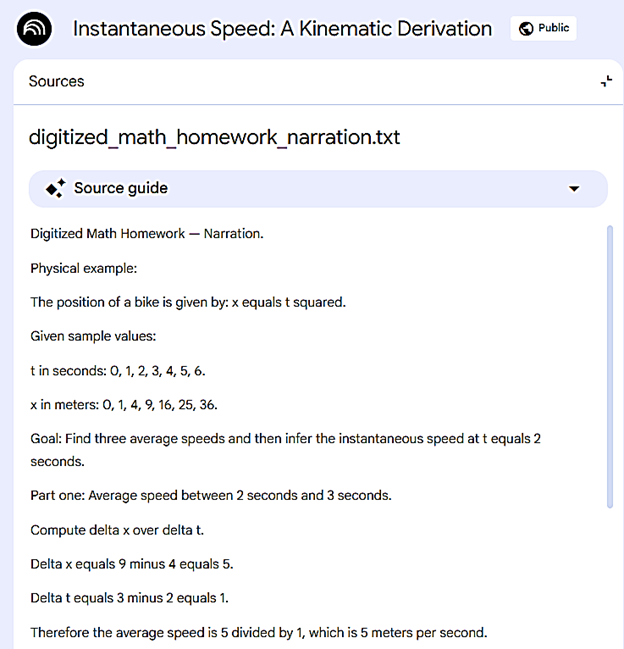
First, I generated a text-based narration by uploading a sample handwritten math problem and solution into ChatGPT.edu and asking it to create a human-centered narration of the problem. Then, I loaded the narration text into NotebookLM and asked for a podcast-style overview focused on applying the source to a real-world context. Inspired by just the mention of the bicycle, NotebookLM created an animated discussion of the principles behind the problem and their real-world applications.
A student may study the problem-solving notes by passively reading for a few minutes, but they might listen to an engaging podcast for 10 minutes while working out the problem alongside the AI “hosts.”
Bonus Tip:
Increase the accessibility of your NotebookLM podcast by download the audio file from NotebookLM and uploading it to your YuJa or Panopto media management account. YuJa or Panopto will automatically transcribe the audio for you, and you can edit the transcript to ensure your podcast meets the accessibility standards for high-quality captions and transcription.
