That’s a Wrap! Using Exam Wrappers to Encourage Reflection

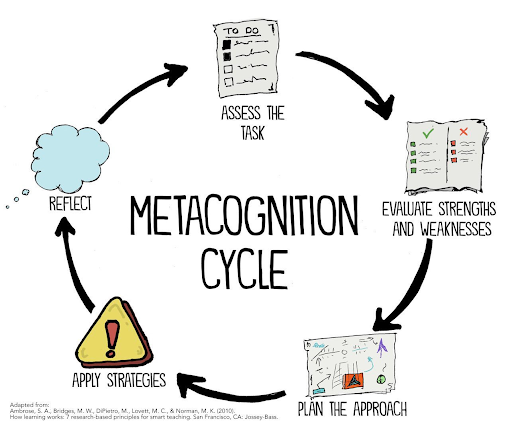
the metacognition cycle: assess the task, evaluate strengths and weaknesses, plan the approach, apply s strategies, reflect, repeat.
Image from “Five Ways to Boost Metacognition in the Classroom” by J. Spencer (2013)

By Jennifer Bland

Have you ever been curious about how much your students are studying for exams, what material they are studying, and how they are preparing for exams?  Exam Wrappers are one way for you to gather this information from your students.  An Exam Wrapper is a written exercise the student completes immediately before or after a graded exam is returned. It is typically completed outside of class for little or no credit, students respond to prompts that require them to reflect on what they did to prepare for the exam, what happened during the
exam, and what they will do to prepare for the next exam to improve performance (Chen, 2016).

Exam Wrappers are good metacognitive exercises for your students to reflect on their learning and the study strategies they used to learn the material. Metacognition is thinking about your thinking.  The Center for Teaching at Vanderbilt University describes metacognition as the “processes used to plan, monitor, and assess one’s understanding and performance” (Chick, 2013).  Students need to be taught how to monitor and assess their learning and thinking, which is why exam wrappers can be helpful.

Many times students will study for an exam, take the exam, then not think about how their study habits or preparation affected the outcomes of the exam or how they could make better habits for a better outcome.  Students also may not think about what they learned and did not learn and what they should continue to work on to be ready for the final exam.  By asking your students to complete the reflective questions, you are guiding them through the metacognitive process. 

Your exam wrapper could take on different forms.  You may want to add a few questions at the end of the exam for students to complete.  You could add it as a separate assignment after they complete the exam.  Maybe you want it to be a form they complete and also complete corrections on the items they missed.

Effective and Adoptable Metacognitive Tools (Chen, 2016) reviews two different teaching tools tested in a college classroom—exam wrappers and quiz correction forms.  They have examples of both that they used with their students along with the results from the study. The Exam Wrapper example is on page 7 and provides a good starting point for you to think about which questions would be helpful to include for your students. Whichever route you decide is best for you and your students, make sure that you keep it simple so that your students will complete it and you have time to grade it.

If you have questions about Metacognitive Strategies you could include in your classes, make an appointment with a member of the CAIFS team! 

Name Tag: Hello, I'm... Blank for someone to write their name

Name Pronunciations and Preferred Names Available in Blackboard Courses

By Celena Kusch

Name Tag: Hello, I'm... Blank for someone to write their name

We know how important it is for us to be the ones who determine how we would like to be recognized and addressed by name. We invite you to use the name pronunciation features in Blackboard to share your preferences with your instructors and classmates. Pronunciations and preferred names help us to acknowledge and demonstrate respect for each other within the Spartan Family. Helping your students to customize their Blackboard presence can help them feel more at home in all their classroom learning spaces.

Find instructions for using these new Blackboard features below:

Instructors will see pronunciations and preferred names in the roster, discussions, gradebook, messages, and wherever you can find names throughout your course.

table with chairs and flowers on table

Relationship Matters: Casual Conversation as Pedagogy

by Dave Marlow

When you sit down together at the Spartans’ Table, you belong.

Belonging is a primary factor in student retention (Costello, et al., 2022). Students who feel connected to their university are more likely to persist in their educational goals. Interacting informally at the Spartan Cafe in the Campus Life Center or at PerkUp in the Library may encourage at-risk students by giving them a personal connection, allowing them to see your human side, and opening up opportunities for them to ask questions or share information that they would avoid in more formal settings (Tinto, 1975). The Spartans’ Table program provides opportunities for faculty and staff to share a meal or coffee with students, and CAIFS will pick up your tab.

A casual conversation with professionals contributes to students’ career readiness as it offers them experience in soft skills (Guerin, 2015) and social intelligence (Ganaie and Mudasir, 2015) which are critical to success in nearly every career field. The rapport enabled by such conversation also contributes to students’ success in disciplinary content (Granitz, et al., 2009).  Finally, connections to campus matter greatly in the student experience (Cuseo, 2008) – especially for students like ours who work multiple jobs, spend little time on campus and view their on-campus time as a necessity rather than a pleasure.

Good things happen when we talk to each other. Sodexo and the Provost’s office, together with the CAIFS team, offers all faculty (adjunct, non-tenure track, and tenure track) and staff (e.g. advisors, students affairs staff, etc.) will buy lunch or coffee for both you and your students up to twice per semester (sign up on the Spartan’s Table website).

ALL faculty and staff, full- and part-time, are welcome to join students at Spartans’ Table!

Research suggests part-time instructors and staff have a powerful impact on students.
faculty spotlight chris bender

Faculty Spotlight: Chris Bender and Flipped STEM Courses

Faculty Spotlight Chris Bender in neon lights
Want to give someone a shout-out?
Email academicinnovation@uscupstate.edu!

Even before COVID-19 forced us all online, Chris Bender, Associate Professor of Chemistry, was already rethinking his Chemistry 111 course in Spring 2020. The Smith Building was being closed for renovations and CHEM U111 had a long history of high withdrawal rates. With building renovations forcing courses to become hybrid due to space limitations, would the withdrawal rate climb even higher? To prepare for a transition to a hybrid course in Fall 2020 (at least what was supposed to be in Fall 2020), Dr. Bender applied to the inaugural Engaged Pedagogy and Hybrid Course Design Institute with CAIFS in Summer 2020. After a few months of training and course planning to implement a flipped classroom with active learning, the course went live in Fall 2020…and has remained flipped, active, and collaborative ever since.

Dr. Bender presented findings from the new CHEM 101 course at the Fall Course Showcase. Watch the 15-minute video below to find out what happened to the W rate after the transition and to learn about students really think about those 6-minute videos!

three roads leading to three different people on computers

Three Steps to Active Learning: Encounter, Engage, Reflect

image of three different people at different computers from 3 different roads.
Image from Top Hat’s “How Active Learning Engages Students in The Virtual Classroom”

By Jennifer Bland

When teaching in online and hybrid courses, you may find it helpful to think through the framework of Encounter, Engage, and Reflect.  How will your students encounter the information you are presenting?  How will your students engage with the information they need to learn?  How will you have students reflect on their learning?

Encounter

In online and hybrid courses, students may encounter information through outside videos, short instructor-created lectures, readings from the textbook, articles, or case studies.  Students could listen to podcasts, complete lab work and experiments, read or create a project, play games or participate in simulations, or read a blog.   

Engage

Students could engage with content by participating in a group read on Perusall, completing discussion board or VoiceThread activities, and applying course topics to real-world examples and case studies.  Students could have debates in small groups on VoiceThread with assigned perspectives.  They could record themselves working out a math or chemistry problem and talking through how they found their solution.  Students could create a concept map to show connections between course content or draw pictures to show a process.  Maybe you have students working collaboratively on Office 365 documents to brainstorm ideas or topics or create a glossary of terms for the course. 

Reflect

How are students going to gauge what they have learned BEFORE the major assignment, test, or essay?  How will students reflect on what they have learned and need to work on more before that summative assignment?  What formative assignments are you providing in your course?

Are you including end of lecture questions?  Are you using exit tickets or end-of-module reflection questions?  Could you include a Muddiest Point or a one-minute paper?  If you were writing a quiz for this topic or module, what 2 questions would you include?  How did ____ go?  What can you do to improve next time?

Want to learn more? Listen to the full hour-long webinar recording from the Active Learning in Hybrid and Online Classes session in August 2021 or visit the Columbia CTL Active Learning for Your Online Classroom page. See the CAIFS Active Learning Innovative Course Design page for tools and resources available to you at USC Upstate.

If you would like to learn more about how to use educational technology in your classes, teaching strategies, or course design, contact academicinnovation@uscupstate.edu or book an appointment with a CAIFS team member.