Over the past several years, USC Upstate faculty have worked diligently to revise and update course materials and are well prepared to meet the April 2026 WCAG compliance deadline. These efforts have resulted in more accessible PDFs, PowerPoint presentations, documents, images, and videos, expanding access to barrier-free course content to a wider range of students. As we build on this important technical foundation, we also have opportunities to think more broadly about accessibility in course design, including how emerging practices like Role, Context, and Task Prompt Engineering can expand the adoption of more Universal Design for Learning practices.
The Role, Context, and Task (RCT) Prompt Engineering Model can be used to generate several assignments for the same learning objective or goal. The prompt engineering RCT examples and add-ons below offer a practical way for faculty to extend their accessibility work into everyday teaching decisions, without requiring a course redesign. Rather than starting from scratch, faculty can use AI tools like Copilot and ChatGPT to quickly generate multiple, flexible assignment options aligned with existing course learning objectives. For example, if students typically complete multiple-choice quizzes and exams, these AI tools can quickly suggest complementary options like written, audio, or video reflections, concept maps, presentations, annotated examples, or case studies to invite students to demonstrate their understanding in different ways.
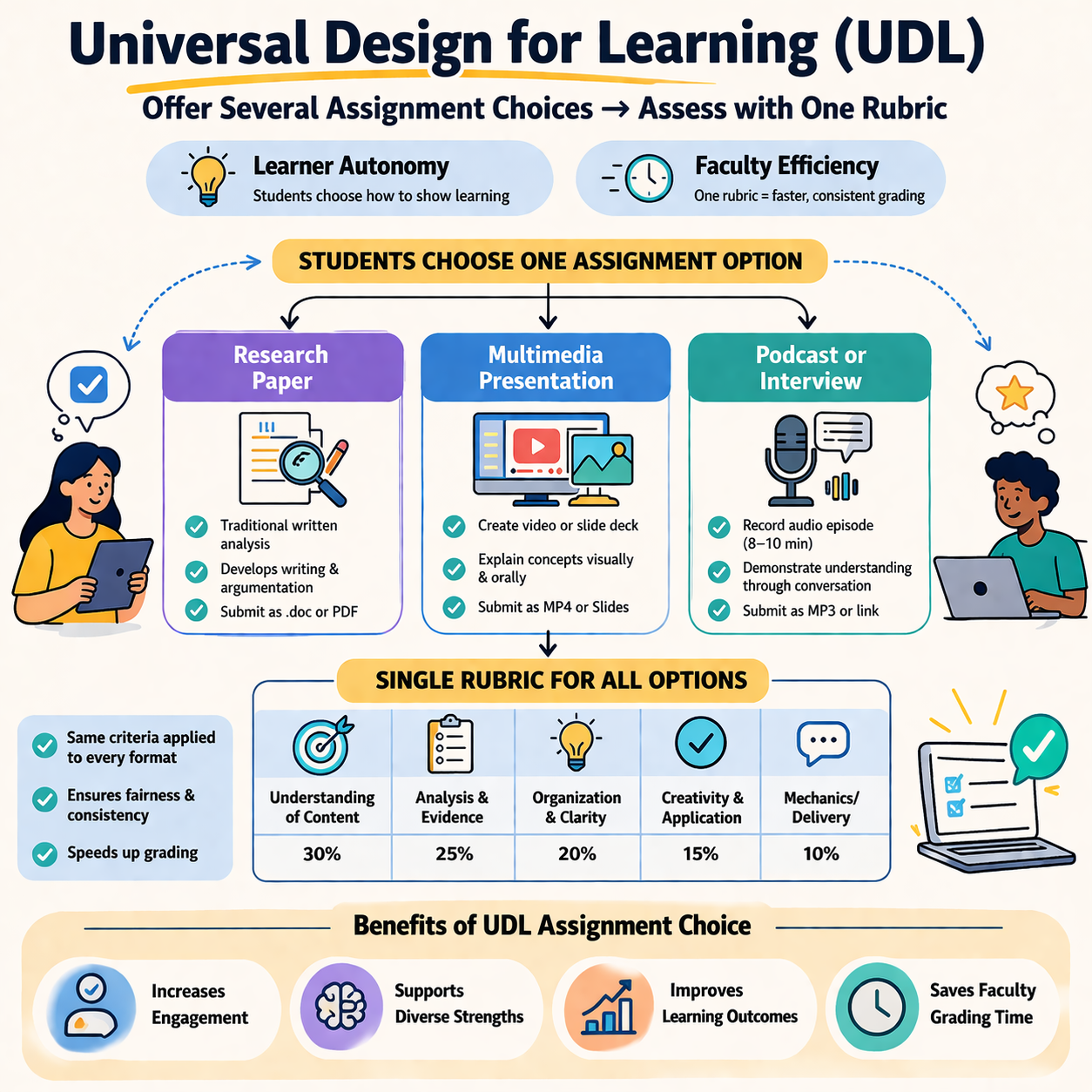
Image long description: Infographic titled “Universal Design for Learning (UDL): Offer Several Assignment Choices → Assess with One Rubric.” It shows three assignment options—research paper, multimedia presentation, and podcast/interview—each with brief descriptions. Arrows lead to a single shared rubric with criteria: understanding of content, analysis and evidence, organization and clarity, creativity and application, and mechanics/delivery, each with percentage weights. Side notes emphasize consistent criteria, fairness, and faster grading. Icons and visuals highlight learner autonomy and faculty efficiency, with a bottom section noting benefits such as increased engagement, support for diverse strengths, improved learning outcomes, and saved grading time.
Ready to give it a try? Below are several frames you can use to get started with prompting AI tools to generate flexible, choice assignments that keep students engaged, motivated, and learning.
Role, Context, Task: You are an experienced [content] college faculty member with a commitment to Universal Design for Learning. For your course [course title and other details], generate 3-4 assignment choices to measure [learning objective or goal] that…
Prompt Add Ons:
- connect to past or future course material (give a summary or bullet points of course material) or career readiness (entry level accountant with a ____ company).
- self-assess [course concept].
- nurture students’ self-efficacy or growth mindset for approaching this content.
- integrate peer teaching to explain [this single, challenging concept].
Role, Context, Task: You are a college faculty member working with a group of peers to revise a course [course title] we all teach. Help us create three authentic, end-of-course assignments to measure [learning objective or goal]. Generate transparent instructions and evaluation criteria intentionally using UDL. Ensure the assignment includes…
Prompt Add-Ons:
- built in scaffolds and supports (models, practice examples, or guided prompts).
- checkpoints to receive success-oriented feedback and time to make adjustments/revisions.
- intrinsic motivators (learner autonomy, content value and relevance, student belonging, and learner belief they can succeed).
By using Role, Context, Task Prompt Engineering to integrate UDL principles into our courses, we can engage students in a wider range of deep thinking, including applying concepts, making connections, and solving problems in context. We might also experiment with offering a selection of assignment formats (written video, audio submissions), incorporating low-stakes practices with feedback or inviting students to explain their reasoning and decision-making through visuals, writing, peer-teaching, and discussion. These practices help students take a more active role in shaping how they learn, while giving faculty space to experiment, learn alongside them, and prepare together for teaching, learning, and working in an increasingly AI-enhanced world.
