
When students feel motivated to learn (University of Buffalo, UW-Whitewater, Kennesaw State), we’re likely to see increases in effort, energy, curiosity, and creativity. We might notice they come to class more, are better prepared, and generally seem open to tackling challenging content or leading a group project. Sometimes, though, even the most motivated students can show a dip in their engagement after midterms, and everyone can use a pick me up to push through the second part of the semester. If you’ve noticed this happening in your classes, try these evidence-based practices to reenergize yourself and your students for the next part of the semester!
Continue reading “Motivation After the Midterm”
Responding to Ally Accessibility Scores in Your Courses
The USC Upstate Accessibility Commitment aims to ensure students, faculty, and staff have access to all spaces and materials where learning takes place. Luckily, Blackboard Ultra has made faculty’s role in fulling this commitment easier than ever. The university-adopted quality assurance program holds all courses to a high standard of accessibility, including expectations that all documents use heading style formats, color contrast, and accessible tables; that videos have accurate closed captions; and that audio files or recordings have transcripts to ensure barrier-free learning opportunities for all students. It may sound like a lot of work to manage and create accessible content, but all of our content tools, from Adobe to Word to Blackboard Ultra, have embedded checks and remedies to help us achieve our accessibility goals. Let’s get started!
Continue reading “Responding to Ally Accessibility Scores in Your Courses”A Quick Guide on How to Write Professional Emails: Student Edition
Email is the information currency of the professional world, and the number one way professional people communicate. Focus on the subject line, greeting, body of the email, and signature to demonstrate professionalism in your email communication.
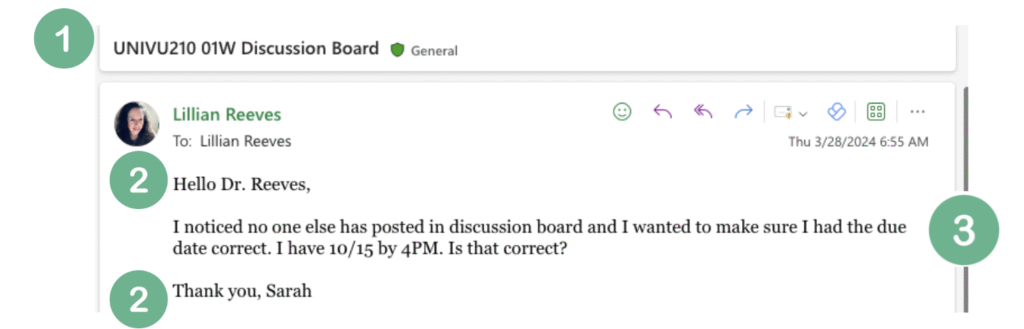
Subject Line

When emailing faculty, include a brief description of what the email is regarding and the course and section number. This info can be found at the top of the Blackboard page.
Example: UNIVU210-01W Discussion Board.
Professional Address

Address your instructor (or employer) in the opening line, then sign your name at the end of the email. By addressing the person you’re emailing in the way they prefer to be addressed, you help them focus on your request.
Example Greeting: Dear Dr. Smith or Prof. Smith,
Example Signature: Thank you, Sarah Jones
Body of the Email
Share your questions or other content in 3-5 clear sentences. If you cannot express your needs in that space, consider visiting office hours or setting up a virtual meeting.
Example: Dear Dr. Smith, I noticed no one else has posted in the discussion board and I wanted to make sure I had the due date correct. I have 10/15 by 4pm. Is that correct? Thank you, Sarah Jones

Before You Hit Send

- Know that you are writing to someone who will answer your questions, who is willing to help you, and who wants to see you succeed.
- Know that your questions and confusion are valid and you can ask them without embarrassment.
- Practice using a neutral, professional tone.
- Review your email for grammar, spelling, and clarity.
Anatomy of a Professional Email
Peer Evaluations Can Lead to Teaching Excellence
Peer teaching evaluations can make even exceptional educators feel anxious or skeptical. But they don’t have to. As long as teaching and learning have worked together to create dynamic classroom environments, the educator and the peer observer have benefitted from this formative collaboration. And here’s how.
Continue reading “Peer Evaluations Can Lead to Teaching Excellence”A Student-Centered Approach to Communication
A recent Pathify study reported the average click rate of emails in higher ed is less than 7%, even though email is the primary mode many institutions use to communicate important information to faculty, staff, and students. Right before the Pandemic, I also discovered that student responses to my emails had noticeably declined. More students were missing programmatic and institutional events and due dates and since then, the trend has become even more pronounced.
Continue reading “A Student-Centered Approach to Communication”Creating Constellations of Meaningful Relationships
When I was in college, one of the RAs would host a weekly watch party for one of her favorite shows, The West Wing. Most of us did not have TVs, so anyone in the dorm or anywhere on campus who heard about it and wanted to go was invited. With her RA funds, she provided food, drinks, and some of the comforts of a home many of us craved. Students arrived early, and stayed late, even when it meant trudging across a snowy campus for the 42 minutes of anticipated joy and fellowship. When she graduated and became a staff member with campus housing, she continued to offer the beloved watch parties. In Peter Felten and Leo Lambert’s book Relationship-Rich Education: How Human Connections Drive Success in College (2020), the West Wing watch parties might be considered one star in what they described as “constellations of meaningful relationships” and experiences students need to feel genuine belonging that can lead to academic success and persistence.
Continue reading “Creating Constellations of Meaningful Relationships”