A Quick Guide on How to Write Professional Emails: Student Edition

Email is the information currency of the professional world, and the number one way professional people communicate. Focus on the subject line, greeting, body of the email, and signature to demonstrate professionalism in your email communication.

Subject Line

person carrying an outsized envelope

When emailing faculty, include a brief description of what the email is regarding and the course and section number. This info can be found at the top of the Blackboard page.

Example: UNIVU210-01W Discussion Board.

Professional Address

Professionally dressed person waving

Address your instructor (or employer) in the opening line, then sign your name at the end of the email. By addressing the person you’re emailing in the way they prefer to be addressed, you help them focus on your request.

Example Greeting: Dear Dr. Smith or Prof. Smith,

Example Signature: Thank you, Sarah Jones

Body of the Email

Share your questions or other content in 3-5 clear sentences. If you cannot express your needs in that space, consider visiting office hours or setting up a virtual meeting.

Example: Dear Dr. Smith, I noticed no one else has posted in the discussion board and I wanted to make sure I had the due date correct. I have 10/15 by 4pm. Is that correct? Thank you, Sarah Jones

Before You Hit Send

Person smiling and standing confidently with hands on hips
  1. Know that you are writing to someone who will answer your questions, who is willing to help you, and who wants to see you succeed.
  2. Know that your questions and confusion are valid and you can ask them without embarrassment.
  3. Practice using a neutral, professional tone.
  4. Review your email for grammar, spelling, and clarity.

Anatomy of a Professional Email
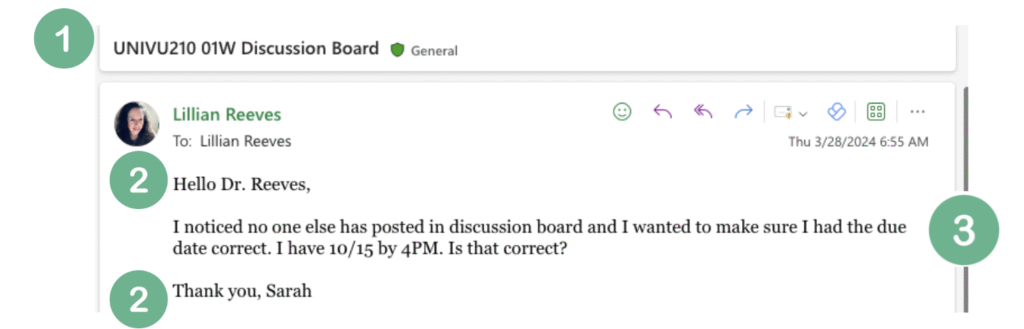
Screenshot of a sample email with 1. Subject line with course and section number, 2. Greeting and Signature, and 3. Concise and professional body of the email.

Peer Evaluations Can Lead to Teaching Excellence

Peer teaching evaluations can make even exceptional educators feel anxious or skeptical. But they don’t have to. As long as teaching and learning have worked together to create dynamic classroom environments, the educator and the peer observer have benefitted from this formative collaboration. And here’s how.  

Continue reading “Peer Evaluations Can Lead to Teaching Excellence”

A Student-Centered Approach to Communication

A recent Pathify study reported the average click rate of emails in higher ed is less than 7%, even though email is the primary mode many institutions use to communicate important information to faculty, staff, and students. Right before the Pandemic, I also discovered that student responses to my emails had noticeably declined.  More students were missing programmatic and institutional events and due dates and since then, the trend has become even more pronounced. 

Continue reading “A Student-Centered Approach to Communication”

Creating Constellations of Meaningful Relationships

When I was in college, one of the RAs would host a weekly watch party for one of her favorite shows, The West Wing. Most of us did not have TVs, so anyone in the dorm or anywhere on campus who heard about it and wanted to go was invited. With her RA funds, she provided food, drinks, and some of the comforts of a home many of us craved. Students arrived early, and stayed late, even when it meant trudging across a snowy campus for the 42 minutes of anticipated joy and fellowship. When she graduated and became a staff member with campus housing, she continued to offer the beloved watch parties. In Peter Felten and Leo Lambert’s book Relationship-Rich Education: How Human Connections Drive Success in College (2020), the West Wing watch parties might be considered one star in what they described as “constellations of meaningful relationships” and experiences students need to feel genuine belonging that can lead to academic success and persistence.  

Continue reading “Creating Constellations of Meaningful Relationships”

College is Just the Place for Transformative Experiences

Attending college, like other big moments of transition in our lives, is full of exciting and nerve-racking opportunities for learners everywhere to give an emphatic or shaky yes! to the newness of people, places, and ideas. But how do students get the most out of these opportunities?

Continue reading “College is Just the Place for Transformative Experiences”

Faculty Spotlight: Colby King

By fall semester, Forbes, Reddit, the NYT, and Berkeley Engineering were among the legions describing 2023 as the soft launch of the “the AI revolution”.  CAIFS (Center for Academic Innovation and Faculty Support) also anticipated the permanence of AI and kicked-off the fall semester with faculty guidance and discussion on the emerging multitudes of AI tools. Some particular attention was given to how to use AI to streamline, standardize, and improve aspects of our own practices. (see TIP blog from September 7 for more information about ways faculty can use AI).

Continue reading “Faculty Spotlight: Colby King”