Active Learning Leads to Student Success

active learning classroom with chairs and tables on wheels, multiple monitors and multiple whiteboards around the room.

Ten years ago, USC Upstate launched its first Active Learning Institute and installed its first active learning classrooms with support from a Title III federal grant. Today, we have 11 state-of-the-art, flexible classrooms in 6 buildings and 100s of enrollments in active learning classes each year.

The results of this 10-year effort are impressive. Over 8,000 unique students have enrolled in active learning courses from 2019-2024 alone. Of our current faculty members, 74 are Active Learning or Engaged Pedagogy Fellows, and many more faculty–especially adjunct faculty–have used their active learning credentials to successfully find full-time teaching positions.

Even more significantly, 94% of the students enrolled in active learning courses from 2021-2023 persisted–meaning they either graduated successfully or returned to USC Upstate the following semester to continue their academic careers. Of the six recent teaching excellence award winners featured in our fall faculty spotlight, three are Engaged Pedagogy Faculty Fellows and one is an Active Learning Faculty Fellow.

What Is Active Learning?

Active Learning is a high-impact teaching practice that meaningfully engages students in interactions with each other and with the course content to enable them to be “co-creators of knowledge.” Students are active participants in class sessions and in their own learning. Implementing active learning strategies means shifting the focus of instruction away from transmitting the instructor’s knowledge to constructing the learners’ knowledge and skills through guided tasks, interactions, assignments, and environments that cultivate deep, meaningful learning.

Active learning strategies can be used in any instructional mode–from face-to-face to online–and in classes of any size, including large nursing or anatomy and physiology courses. USC Upstate’s intensive Engaged Pedagogy and Hybrid Course Design Institute helps to prepare instructors to design hybrid courses to take advanced of flipped learning in online spaces along with rich, interactive learning face-to-face.

Find out more information about Active Learning in our CAIFS Resources for Innovative Course Design. Check out our profiles of Engaged Pedagogy Fellows Astrid Rosario (NSE), Kristi Miller (MBCON), and Shannon Polchow (LLC) to see active learning strategies at work in USC Upstate classrooms.

Active Learning Infographic summarizing results described in this article, including number of classrooms, faculty, students, and student retention rates.
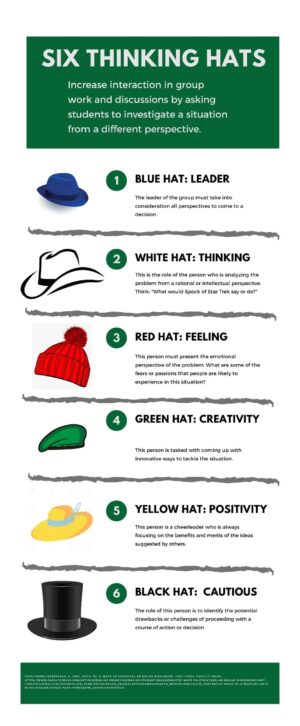
SIX THINKING HATS Increase interaction in group work and discussions by asking students to investigate a situation from a different perspective. Hats represent roles for leader, thinking/logic, feeling, creativity, positivity, and cautious

Group Work and Collaborative Learning

Collaborative learning is a well-established high-impact practice (HIPs). According to the Association of American Colleges and Universities, collaborative learning has two main goals: the first is to have students work together to solve problems or find solutions. And the second is for students to gain access to perspectives, experiences, and information they may have not yet considered or had access to.  Collaborative learning can be a small pair-share experience after a micro-lecture or it can be a larger, weeks-long group research project.

Continue reading “Group Work and Collaborative Learning”

That’s a Wrap! Using Exam Wrappers to Encourage Reflection

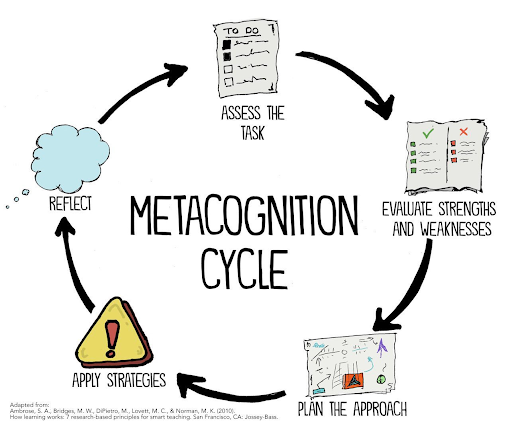
the metacognition cycle: assess the task, evaluate strengths and weaknesses, plan the approach, apply s strategies, reflect, repeat.
Image from “Five Ways to Boost Metacognition in the Classroom” by J. Spencer (2013)

By Jennifer Bland

Have you ever been curious about how much your students are studying for exams, what material they are studying, and how they are preparing for exams?  Exam Wrappers are one way for you to gather this information from your students.  An Exam Wrapper is a written exercise the student completes immediately before or after a graded exam is returned. It is typically completed outside of class for little or no credit, students respond to prompts that require them to reflect on what they did to prepare for the exam, what happened during the
exam, and what they will do to prepare for the next exam to improve performance (Chen, 2016).

Exam Wrappers are good metacognitive exercises for your students to reflect on their learning and the study strategies they used to learn the material. Metacognition is thinking about your thinking.  The Center for Teaching at Vanderbilt University describes metacognition as the “processes used to plan, monitor, and assess one’s understanding and performance” (Chick, 2013).  Students need to be taught how to monitor and assess their learning and thinking, which is why exam wrappers can be helpful.

Many times students will study for an exam, take the exam, then not think about how their study habits or preparation affected the outcomes of the exam or how they could make better habits for a better outcome.  Students also may not think about what they learned and did not learn and what they should continue to work on to be ready for the final exam.  By asking your students to complete the reflective questions, you are guiding them through the metacognitive process. 

Your exam wrapper could take on different forms.  You may want to add a few questions at the end of the exam for students to complete.  You could add it as a separate assignment after they complete the exam.  Maybe you want it to be a form they complete and also complete corrections on the items they missed.

Effective and Adoptable Metacognitive Tools (Chen, 2016) reviews two different teaching tools tested in a college classroom—exam wrappers and quiz correction forms.  They have examples of both that they used with their students along with the results from the study. The Exam Wrapper example is on page 7 and provides a good starting point for you to think about which questions would be helpful to include for your students. Whichever route you decide is best for you and your students, make sure that you keep it simple so that your students will complete it and you have time to grade it.

If you have questions about Metacognitive Strategies you could include in your classes, make an appointment with a member of the CAIFS team! 

three roads leading to three different people on computers

Three Steps to Active Learning: Encounter, Engage, Reflect

image of three different people at different computers from 3 different roads.
Image from Top Hat’s “How Active Learning Engages Students in The Virtual Classroom”

By Jennifer Bland

When teaching in online and hybrid courses, you may find it helpful to think through the framework of Encounter, Engage, and Reflect.  How will your students encounter the information you are presenting?  How will your students engage with the information they need to learn?  How will you have students reflect on their learning?

Encounter

In online and hybrid courses, students may encounter information through outside videos, short instructor-created lectures, readings from the textbook, articles, or case studies.  Students could listen to podcasts, complete lab work and experiments, read or create a project, play games or participate in simulations, or read a blog.   

Engage

Students could engage with content by participating in a group read on Perusall, completing discussion board or VoiceThread activities, and applying course topics to real-world examples and case studies.  Students could have debates in small groups on VoiceThread with assigned perspectives.  They could record themselves working out a math or chemistry problem and talking through how they found their solution.  Students could create a concept map to show connections between course content or draw pictures to show a process.  Maybe you have students working collaboratively on Office 365 documents to brainstorm ideas or topics or create a glossary of terms for the course. 

Reflect

How are students going to gauge what they have learned BEFORE the major assignment, test, or essay?  How will students reflect on what they have learned and need to work on more before that summative assignment?  What formative assignments are you providing in your course?

Are you including end of lecture questions?  Are you using exit tickets or end-of-module reflection questions?  Could you include a Muddiest Point or a one-minute paper?  If you were writing a quiz for this topic or module, what 2 questions would you include?  How did ____ go?  What can you do to improve next time?

Want to learn more? Listen to the full hour-long webinar recording from the Active Learning in Hybrid and Online Classes session in August 2021 or visit the Columbia CTL Active Learning for Your Online Classroom page. See the CAIFS Active Learning Innovative Course Design page for tools and resources available to you at USC Upstate.

If you would like to learn more about how to use educational technology in your classes, teaching strategies, or course design, contact academicinnovation@uscupstate.edu or book an appointment with a CAIFS team member.